
How NeoAir’s Triangular Core Matrix Actually Traps Heat — The Science Behind Our Warmest Sleeping Pads
When you’re camping at 10,000 feet in October, the ground temperature can drop thirty degrees below freezing — and a standard foam pad won’t cut it. That’s why we engineered the Triangular Core Matrix, the core sleeping pad insulation technology inside every NeoAir pad we make.
This guide walks through how that internal structure actually traps heat, why the triangular shape matters, and what each layer does when you’re lying on it at night. We’re pulling back the curtain on the engineering so you know exactly what’s keeping you warm.
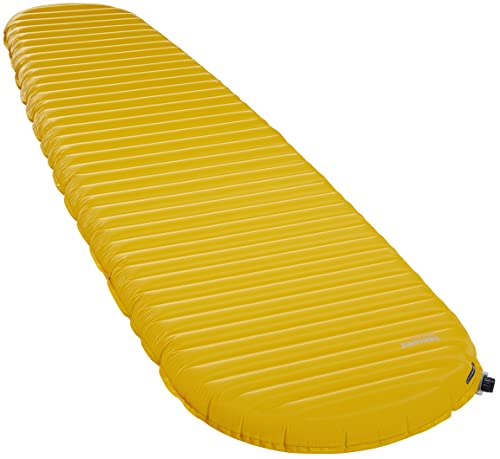
Why Triangular Baffles Instead of Rectangular Cells
Most inflatable pads use straight vertical baffles — fabric walls that run lengthwise to create rectangular air chambers. We took a different approach: our Triangular Core Matrix stacks hundreds of triangular cells in alternating rows, creating a truss-like lattice inside the pad.
The geometry matters because triangular shapes distribute pressure more evenly across the pad’s surface. When you lie down, your body weight pushes against the top fabric, and triangular cells resist collapse better than rectangles — they hold their shape under load, so the air layer beneath you stays intact all night.
That shape also creates more internal surface area for the same pad thickness. More internal fabric means more places for our reflective ThermaCapture coating to bounce radiant heat back toward your body, which we’ll cover in the next section.
The ThermaCapture Layer and Radiant Heat Reflection
How Metallized Film Works
Inside every NeoAir pad, the baffle walls are coated with a thin metallized film we call ThermaCapture. This layer does one job: reflect radiant heat.
Your body constantly emits infrared radiation — even when you’re asleep and your metabolism slows, you’re radiating heat in all directions. Without a reflective barrier, that energy passes straight through the pad’s fabric and air chambers into the ground. ThermaCapture bounces a portion of that radiation back toward you before it escapes.
Why Air Alone Isn’t Enough
Air is an excellent insulator when it’s trapped and still, but it doesn’t block radiant heat. The Therm-a-Rest NeoAir XTherm NXT Sleeping Pad combines both principles: the Triangular Core Matrix traps air to stop conductive heat loss through contact, and the ThermaCapture coating stops radiative loss through emission.
Together, those two mechanisms deliver an R-value of 7.3 in a pad that packs smaller than a one-liter water bottle.
How Inflation Pressure Affects Insulation Performance
The Triangular Core Matrix only works when the pad is fully inflated. Under-inflation collapses the triangular cells, reducing the thickness of the trapped-air layer and bringing your body closer to the ground.
We recommend inflating until the pad feels firm but not drum-tight — you should sink in slightly when you press your palm into it, but the surface shouldn’t dimple deeply. That firmness keeps the internal structure stable so the air chambers maintain their intended thickness all night.
Altitude and Temperature Effects
Air expands as temperature rises and contracts as it cools. If you inflate your pad in a warm tent and then carry it outside into freezing temperatures, the air inside will shrink and the pad will feel softer. Likewise, if you inflate at sea level and then hike to 8,000 feet, the lower atmospheric pressure will cause the pad to expand slightly.
For cold-weather trips, check your pad’s firmness after it acclimates to the overnight temperature. A few extra breaths can restore the correct pressure if the air has contracted. Using a Therm-a-Rest NeoAir Micro Pump – Rechargeable Sleeping Pad Inflator makes adjustments quick and saves your lungs when you’re already tired from the day’s miles.

Comparing R-Values Across the NeoAir Line
Every NeoAir pad uses the same Triangular Core Matrix architecture, but the number of internal layers and the thickness of the ThermaCapture coating vary by model. That’s how we dial in different R-values for different use cases.
The NeoAir XLite NXT Sleeping Pad balances warmth and weight for three-season backpacking, with an R-value of 4.5 and a packed weight under one pound. The XTherm NXT, by contrast, adds more internal layers and a thicker reflective coating to reach R-7.3 for winter mountaineering.
Three-Season vs. Winter-Rated Pads
If you’re camping above freezing, a three-season pad like the Therm-a-Rest NeoAir Venture Sleeping Pad provides enough insulation without the extra weight of a winter model. Once overnight lows drop below 20°F, the additional layers in a winter-rated pad become necessary to prevent cold spots from forming under your hips and shoulders.
The sleeping pad insulation technology inside every NeoAir is the same — the difference is how many layers of that technology we stack inside the pad. More layers mean more trapped air and more reflective surface area, which translates directly to a higher R-value.
Why Internal Structure Matters More Than Material Alone
The warmest sleeping pad isn’t the one made from the thickest fabric or filled with the most exotic insulation. It’s the one that traps air in a stable structure and reflects radiant heat back toward your body.
That’s what the Triangular Core Matrix does — and it’s why we’ve built every NeoAir pad around this architecture since we introduced it. The engineering isn’t visible from the outside, but it’s the reason you stay warm on a snow platform in February or on a granite ledge at 13,000 feet.
When you’re choosing a pad, look past the shell fabric and focus on what’s happening inside. The internal structure is what determines whether you’ll sleep warm or wake up shivering at 3 a.m.
Common Questions About NeoAir’s Heat-Trapping Design
The internal structure is heat-welded, not glued, so the baffle walls won’t delaminate with normal use. The ThermaCapture coating is bonded to the fabric and doesn’t wear off.
What does degrade over time is the outer fabric’s water-resistance and the valve’s seal integrity. If you notice the pad losing air overnight after a few years, check the valve first — that’s the most common failure point.
Cold air is denser than warm air, so it compresses more easily under your body weight. The pad may be at the same internal pressure, but the cold air inside won’t push back as firmly against the top fabric.
This is normal and doesn’t reduce the pad’s insulation value. The Triangular Core Matrix still traps the same volume of air, and the ThermaCapture layer still reflects the same amount of radiant heat.
Yes — stacking a closed-cell foam pad beneath your NeoAir will increase the overall R-value by blocking additional ground contact. This is common for winter camping when every degree counts.
The foam layer also protects the NeoAir’s fabric from sharp rocks and frozen ground, which reduces the risk of punctures.
Foam pads rely purely on trapped air within the foam’s cell structure — they have no reflective layer. NeoAir pads combine trapped air with a metallized coating, which is why they deliver higher R-values at a fraction of the thickness and weight.
Foam pads are more durable and don’t require inflation, so they’re still the right choice for certain trips. But gram-for-gram, the Triangular Core Matrix delivers more insulation per ounce than any foam pad can.
The pad needs to be firm enough that the triangular cells stay fully extended when you lie down. If you can feel the ground through the pad or if your hips sink all the way to the bottom fabric, the insulation layer is too thin to perform as designed.
A good field test: press your palm into the pad. You should sink in about half an inch, but the fabric should spring back immediately when you lift your hand.
Earlier versions of reflective sleeping pads used crinkly aluminized Mylar, which was loud when you shifted position at night. NeoAir’s ThermaCapture is a bonded metallized film, not loose foil, so it doesn’t produce the same crackling sound.
You’ll hear some fabric rustle when you move — that’s the nylon shell, not the reflective layer. It’s quieter than most crinkly pads but not silent.