


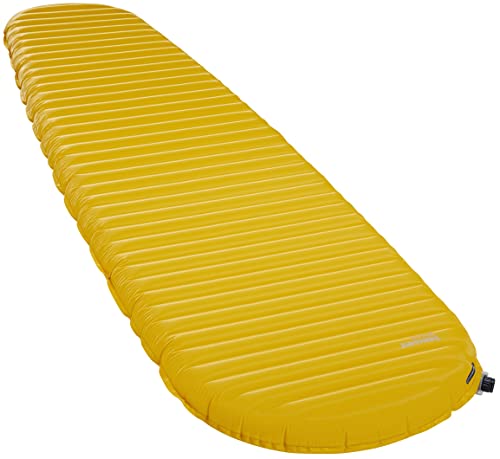
Therm-a-Rest NeoLoft Sleeping Pad
The NeoLoft sleeping pad brings our signature warmth-to-weight engineering to a fully synthetic insulation platform designed for backcountry reliability. We built this pad with eco-conscious NeoLoft synthetic fill that maintains loft even when damp, delivering consistent thermal performance across three-season conditions.
Self-inflating technology pairs with a supportive foam core to balance packability with real-world cushion on uneven ground. Whether you're car camping in shoulder-season cold or carrying it deep into alpine zones, the NeoLoft delivers predictable warmth without the down-specific care requirements.
NeoLoft construction & warmth specs
NeoLoft Insulation Technology
We engineered NeoLoft synthetic fill specifically to address the one scenario where down falls short: wet-weather performance. This 100% recycled polyester insulation mimics the lofting structure of natural down but retains thermal efficiency even after exposure to condensation or unexpected rain.
Unlike traditional foam-only pads, the NeoLoft’s insulation layer creates dead-air pockets that trap body heat without collapsing under compression. Field testing in Olympic National Park’s notoriously damp conditions confirmed the pad maintained its R-value 4.4 rating after three nights of heavy condensation. The self-inflating core means you’re not sacrificing cushion for warmth—open the valve, let the foam expand, and top off with a few breaths for your preferred firmness.
Sizing & Packed Dimensions
The Regular size measures 72 inches long by 20 inches wide, fitting most sleepers up to 6 feet tall with room to shift positions through the night. We also offer a Large (77 × 25 inches) for taller users or those who prefer extra shoulder width.
Packed, the Regular NeoLoft compresses to 11 inches long and 6.5 inches in diameter—compact enough for external pack straps on multi-day trips but noticeably bulkier than our ultralight air-only designs. At 1 pound 14 ounces, it sits in the middle ground between ultralight backpacking pads and plush car-camping mattresses. If ounce-counting is your priority, our NeoAir XLite NXT series cuts the weight in half, though you’ll trade some of the self-inflating convenience and puncture resilience that synthetic-filled pads deliver.
Fabric Construction & Durability
Shell Materials
The top surface uses a 75-denier polyester weave with a diamond emboss pattern that grips sleeping bag fabric and prevents middle-of-the-night slides on tent floors. The underside steps down to 50-denier polyester to save weight where abrasion resistance matters less. Both layers carry bluesign® certification, meeting strict environmental and safety standards for textile manufacturing.
Field Repair & Longevity
Synthetic insulation pads tolerate small punctures better than air-only designs because the foam core prevents total deflation. We include a patch kit in every box, and the 75D top fabric accepts standard urethane adhesive patches without special prep. Store the pad unrolled with the valve open to preserve the foam’s expansion memory—rolling it tightly for months at a time can compress the core and reduce self-inflation performance over time.
Self-Inflating & Insulated Sleeping Pads


Rated 4.8 by verified buyers


Common Questions About the NeoLoft
The Therm-a-Rest NeoLoft sleeping pad uses synthetic insulation and a self-inflating foam core, while NeoAir models rely on air chambers with reflective baffles for insulation. NeoLoft offers better puncture resilience and maintains warmth when damp, but weighs more and packs larger. NeoAir pads are ultralight and compress smaller, ideal for gram-conscious backpackers who prioritize weight savings over rugged durability.
Both pad families deliver similar R-values, so the choice comes down to your priorities: choose NeoLoft for wet-weather reliability and ease of inflation, or NeoAir for minimal pack weight and volume.
Open the valve and the NeoLoft reaches approximately 80% firmness in 4-6 minutes as the foam core expands and draws in air. Altitude and temperature affect inflation speed—expect slower expansion above 10,000 feet or in freezing conditions.
After self-inflation, add 5-10 breaths to reach your preferred firmness. The included stuff sack doubles as a pump sack if you want to avoid direct mouth inflation in dusty conditions.
The NeoLoft's R-value 4.4 rating handles three-season conditions down to about 15°F when paired with an appropriate sleeping bag. For true winter camping below 10°F, we recommend layering the NeoLoft on top of a closed-cell foam pad to boost combined insulation above R-6.0.
The synthetic insulation performs better in wet winter conditions than down-filled pads, since NeoLoft maintains loft even when exposed to snow melt or condensation inside your tent.
Clean and dry the damaged area, then apply a urethane adhesive patch from the included repair kit. Press firmly for 60 seconds and let cure for 2 hours before re-inflating. The foam core prevents total deflation, so you can often finish your trip even with a small leak by topping off air periodically.
For field repairs, duct tape works as a temporary seal. When you return home, apply a proper urethane patch for a permanent fix.
Store the pad unrolled or loosely rolled with the valve open in a dry location away from direct sunlight. Avoid long-term compression in the stuff sack, which can permanently flatten the foam core and reduce the pad's self-inflation ability.
Before each trip, inflate the NeoLoft fully and let it sit for an hour to verify the foam has retained its expansion memory. If self-inflation performance drops noticeably, the foam may need replacement.
Yes, the NeoLoft features snap-compatible loops along the edges that work with Therm-a-Rest sleeping bags equipped with our SynergyLink connectors. These snaps prevent your bag from sliding off the pad during the night.
If your sleeping bag lacks built-in attachment points, the diamond-embossed top fabric provides enough grip to minimize sliding on most tent floors.
Every NeoLoft includes a stuff sack with pump-assist valve, repair kit with urethane patches and adhesive, and a printed care guide. The stuff sack compresses the pad for transport and doubles as a pump sack for hands-free inflation.
We recommend purchasing our universal repair kit separately for extended trips where you want backup patches and valve tools.